
What a Blown-In Garage Door Actually Costs You
Skip this check one more season and here's the realistic outcome: a gust catches a weak panel or worn track, the door buckles or comes off its rollers, and you're left with an open hole in your house during the exact weather you needed protection from. Rain and wind-driven debris get into the garage, soak into drywall and stored belongings, and in older homes a failed garage door can pull enough on the structure to stress the roof framing above it. Replacing a damaged section, realigning bent tracks, and drying out water damage costs far more than the hour it takes to inspect and tighten things up now, before the next front moves through.
Why the Garage Door Is the Weakest Wall in the House
Every other wall in your home is a solid, continuous structure. The garage door is not. It's the largest opening in most houses, built from thin steel or composite panels, hung on tracks, and held shut by springs and a handful of rollers and hinges. When wind hits the front of a house, pressure builds against that door differently than against a framed wall. If the door fails first, the sudden pressure change inside the garage can push upward on the roof structure from underneath, which is why building codes in many wind-prone regions require reinforced or wind-rated garage doors. Chicago sits squarely in a corridor that gets both spring severe weather and strong straight-line wind events in fall as cold fronts sweep through, so this isn't a one-season concern. It's worth treating the garage door as a structural component, not just an appliance.
Signs Your Door Won't Hold Up in High Wind
- Loose or missing track bolts — tracks that flex or wiggle when you push on them won't keep rollers seated under wind pressure.
- Bent or dented panels — even cosmetic-looking dents can be points where a panel buckles first under load.
- Worn rollers and hinges — grinding, uneven movement, or visible rust weakens the connection between panels and tracks.
- Cracked or missing weatherstripping — beyond drafts, this is often where wind-driven rain finds its way in first.
- A door that shudders or bows — if the center of the door visibly flexes when the wind picks up, the panels or bracing aren't rated for the load they're seeing.
Steps to Take Before the Next Wind Event
1. Tighten and inspect the hardware
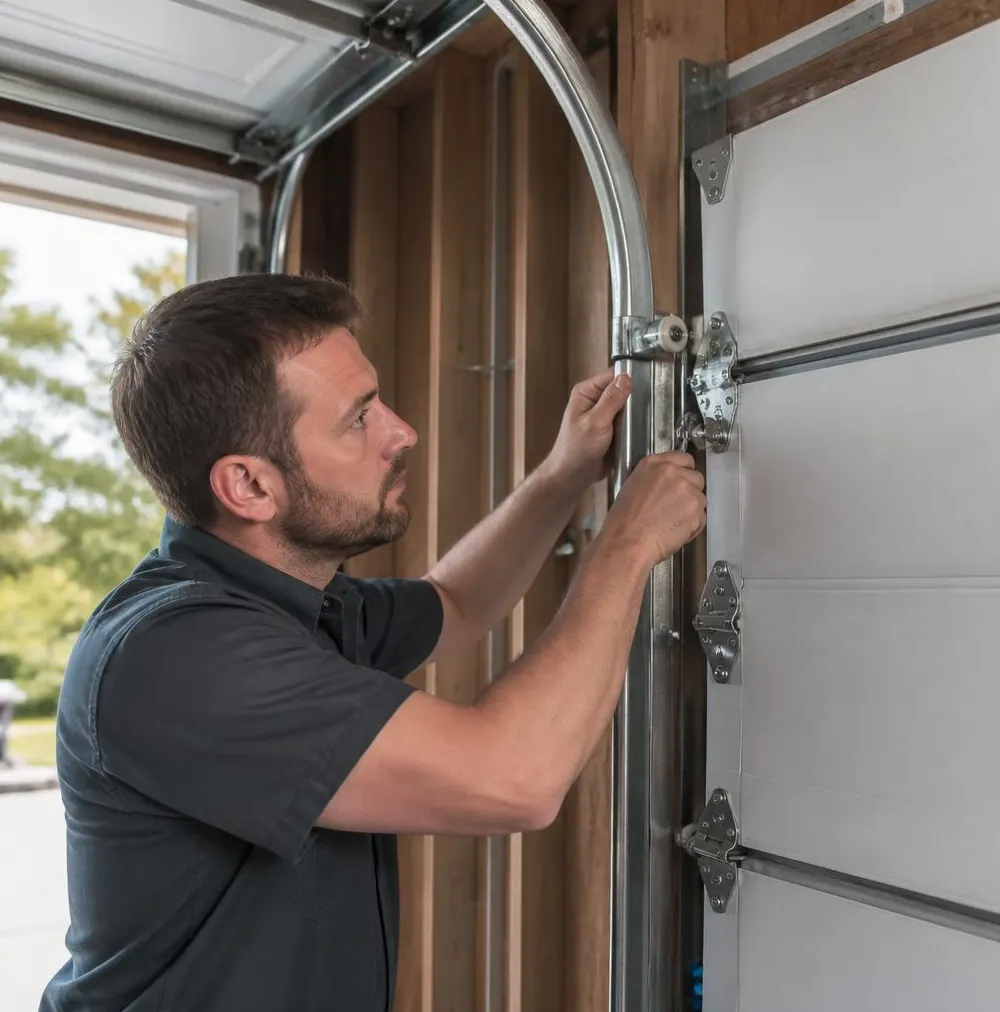
Walk the full track system and check every bolt, bracket, and hinge. Loose hardware is the single easiest fix and the most common point of failure. Replace any rusted or stripped bolts rather than just snugging them.
2. Check panels for existing damage
Look along the bottom and middle panels for dents, cracks, or separation at the seams. Damage that seems minor now can become a failure point when wind load hits it directly.
3. Add bracing if the door doesn't already have it
Horizontal bracing kits reinforce panels against bowing in high wind. If your door is original to an older home and has no internal bracing, this is one of the most effective upgrades you can make without replacing the whole unit.
4. Replace worn weatherstripping
New stripping along the sides, top, and bottom reduces both water intrusion and the amount of wind that can get a grip on the door edges.
5. Confirm the springs are doing their job
Springs under the wrong tension make a door harder to control manually and can cause it to react unpredictably if the opener loses power mid-storm. A door that's hard to lift by hand, or that slams down fast, needs spring attention before storm season, not after.
6. Know your manual release
If the power goes out during a wind event, you need to be able to operate the door by hand. Test the release mechanism now so it isn't the first time you're using it in an emergency.
The Fall-Into-Winter Factor
Chicago's shoulder season brings its own complication: the same wind events that test your door's structural soundness are also the last warm stretch before ice, road salt, and single-digit nights set in. Rollers and hinges that are already worn from summer humidity won't get easier to deal with once cold tightens the metal and salt spray starts corroding exposed hardware. Doing the wind-prep inspection now covers two problems at once — storm readiness and winter readiness — instead of circling back to the garage twice.
When to Call Chicago Garage Door
If you've found loose track hardware you can't fully secure, a panel that flexes or shows real damage, or springs that feel off, that's a job for a technician rather than a weekend fix. Chicago Garage Door handles garage door maintenance inspections that check tracks, rollers, hinges, and weatherstripping in one visit, and we also handle spring replacement when tension is off or a spring shows wear, so the door operates safely under hand and opener control alike. We serve homeowners and businesses across Chicago's South Side, Evergreen Park, Oak Lawn, Blue Island, Alsip, Calumet City, Orland Park, and Tinley Park.
If you're searching for a garage door company near 60643 or garage door repair on the south side before the next round of fall wind hits, call Chicago Garage Door and get it checked before the storm finds the weak spot for you.